

Best Daily Handwriting Practice Routine (Only 15 Minutes a Day)
- LIB

- Jul 19
- 4 min read
Can just 15 minutes a day improve your child's handwriting?
Absolutely.
Many parents believe that improving handwriting requires hours of repetitive writing. In reality, children develop better handwriting through short, focused, and consistent practice rather than lengthy writing sessions.
Just 15 minutes every day can help improve handwriting, increase writing speed, reduce spelling mistakes, and build confidence in schoolwork.
The secret is not writing more—it is practising the right skills consistently.
Why Handwriting Still Matters
Even in today's digital world, handwriting remains an essential life skill.
Students are still expected to:
Write classwork and homework
Complete examinations within a time limit
Take notes during lessons
Write essays and descriptive answers
Maintain neat notebooks
Teachers often find it easier to understand and evaluate answers that are clearly written. Good handwriting also reflects discipline, attention to detail, and confidence.

The Benefits of a Daily Handwriting Routine
A consistent handwriting routine helps children develop:
Neat and legible handwriting
Better letter formation
Correct spacing between words
Improved writing speed
Better pencil control
Increased concentration
Greater confidence during examinations
Most importantly, daily practice creates muscle memory, making writing smoother and more natural over time.
The Perfect 15-Minute Handwriting Practice Routine
Minutes 1–2: Warm Up the Fingers
Before writing, allow the hands and fingers to loosen up.
Simple warm-up activities include:
Opening and closing the fists
Touching each finger with the thumb
Wrist rotations
Finger tapping on the table
These exercises strengthen fine motor skills and prepare the muscles for writing.
Minutes 3–5: Practise Letter Formation
Choose a small group of letters each day.
For example:
Monday: a, c, e, o
Tuesday: i, l, t
Wednesday: m, n, h
Focus on:
Starting each letter correctly
Maintaining uniform height
Writing smooth curves
Keeping letters on the writing line
Avoid rushing. Neat writing develops through accuracy first, speed later.
Minutes 6–8: Write Simple Words
Once individual letters become comfortable, combine them into words.
Examples include:
school
family
teacher
notebook
beautiful
knowledge
Writing complete words helps children improve letter connections and spacing naturally.
Minutes 9–11: Copy Short Sentences
Ask your child to copy one or two meaningful sentences.
For example:
Practice makes progress.
Every day is a new opportunity to learn.
Neat handwriting reflects careful thinking.
Encourage slow, careful writing instead of trying to finish quickly.
Minutes 12–13: Controlled Speed Practice
Set a timer for one minute.
Ask your child to write neatly while maintaining a comfortable pace.
The objective is not to write as fast as possible.
The objective is to write clearly without losing neatness.
Over several weeks, writing speed improves naturally.
Minutes 14–15: Review the Writing
Children learn faster when they evaluate their own work.
Ask these simple questions:
✔ Are the letters sitting properly on the line?
✔ Are all letters roughly the same size?
✔ Is there enough space between words?
✔ Can someone else easily read the writing?
This habit encourages self-correction and builds attention to detail.
A Weekly Practice Plan
Day | Practice Focus |
Monday | Lowercase letters |
Tuesday | Capital letters |
Wednesday | Words |
Thursday | Sentences |
Friday | Short paragraph |
Saturday | Dictation practice |
Sunday | Review and improvement |
This schedule keeps handwriting practice interesting while strengthening every essential writing skill.
Common Mistakes Parents Should Avoid
1. Making Children Write Too Much
Writing ten neat lines is far more effective than writing ten untidy pages.
Quality always matters more than quantity.
2. Focusing Only on Speed
Many parents ask children to write faster.
However, speed without proper letter formation creates long-term handwriting problems.
Neatness should always come before speed.
3. Correcting Every Small Mistake
Constant criticism reduces motivation.
Instead, praise improvements such as better spacing, straighter writing, or improved letter size.
Positive encouragement builds confidence.
4. Inconsistent Practice
Practising for 15 minutes every day yields better results than practising for 2 hours only on weekends.
Consistency is the key to lasting improvement.
Activities That Improve Handwriting
Handwriting depends on strong fine motor skills.
Children can strengthen these skills through enjoyable activities such as:
Drawing and colouring
Clay modelling
Tracing patterns
Dot-to-dot worksheets
Origami
Threading beads
Maze activities
Puzzle solving
These activities improve finger control without feeling like formal practice.
How Long Does It Take to Improve Handwriting?
Every child learns at a different pace, but with regular practice, you can generally expect:
After 2–3 weeks
Better pencil grip
Improved posture
Increased writing confidence
After 1–2 months
More consistent letter size
Better spacing
Cleaner notebooks
After 3–6 months
Neater handwriting
Faster writing speed
Greater confidence during examinations
Improved presentation of written work
Handwriting Is More Than Beautiful Writing
Good handwriting supports many other academic skills.
Children who write neatly often become more careful with:
Spelling
Grammar
Punctuation
Sentence formation
Written expression
The discipline developed through handwriting practice carries over into overall academic performance.
How LIB Education Helps Students Improve Handwriting
At LIB Education, handwriting improvement is integrated into language learning rather than treated as a separate activity. Our experienced teachers identify the root causes of poor handwriting—such as incorrect pencil grip, inconsistent letter formation, poor spacing, or improper writing posture—and provide personalised guidance to address them.
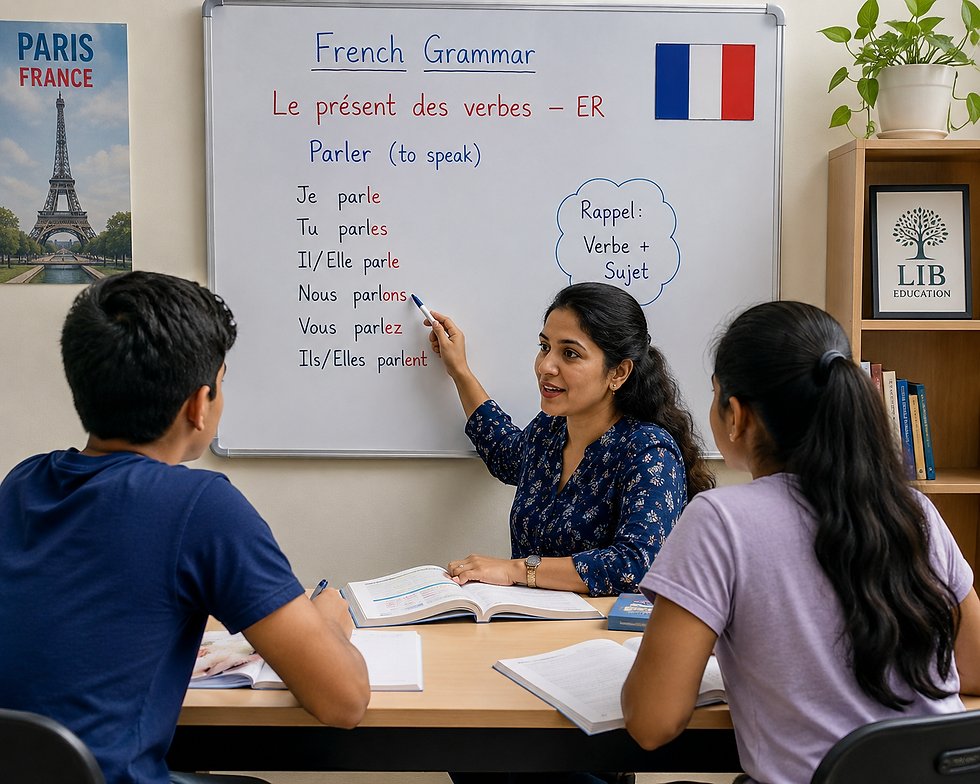
Whether students attend our personalized small-group classes (2–4 students) or one-to-one individual classes, they receive individual attention, regular feedback, and structured practice suited to their learning pace. Alongside handwriting, students also improve their spelling, grammar, reading comprehension, vocabulary, and overall written communication.
We believe that neat handwriting is not about writing beautifully—it is about helping students communicate clearly, confidently, and effectively.
Final Thoughts - Daily Handwriting Practice Routine
Improving handwriting does not require expensive workbooks or hours of repetitive writing.
A simple 15-minute daily routine, followed consistently, can transform a child's handwriting over time.
Encourage your child to practise patiently, celebrate small improvements, and make handwriting a positive daily habit rather than a chore.
Remember, consistency beats intensity. Fifteen focused minutes every day can lead to years of confident, neat, and efficient writing.
If you're looking for personalised guidance to help your child improve handwriting, spelling, and language skills, LIB Education offers expert online and offline Daily Handwriting Practice Routine tuition with experienced teachers, small personalized batches, and one-to-one attention to help every student succeed.


Comments